

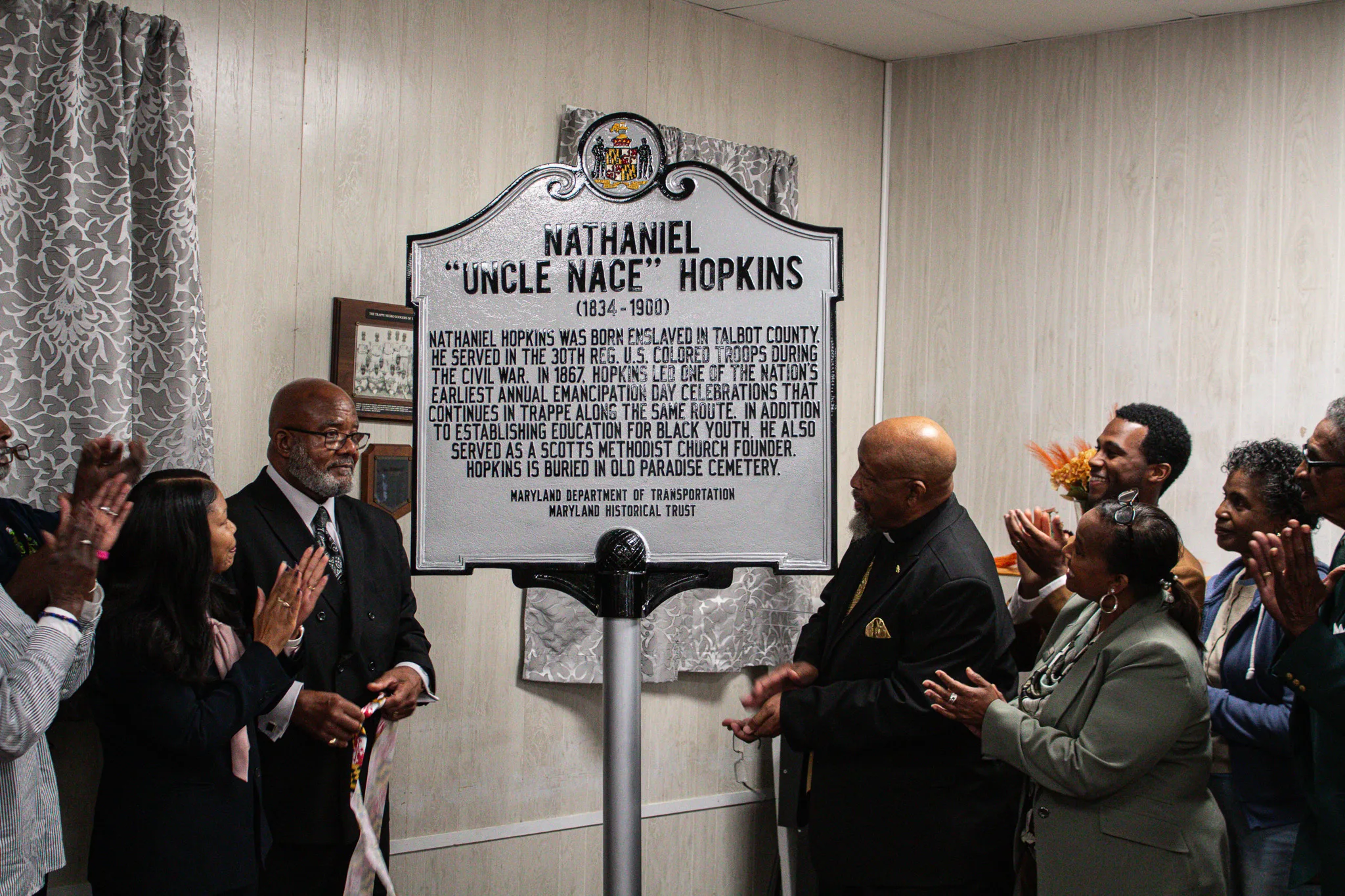
Talbot County Economic Development and Tourism Director Stephanie Mervine joined community members, elected officials, historians, and descendants of Nathaniel “Uncle Nace” Hopkins gathered at Scott United Methodist Church in Trappe on Thursday, October 15, 2026, for the unveiling of an updated Maryland Roadside Historical Marker honoring the Civil War veteran, community leader, and founder of one of the nation’s longest-running Emancipation Day celebrations.
The marker was developed through a partnership between the Maryland Department of Transportation (MDOT), the Maryland Commission on African American History and Culture, and the Maryland Historical Trust.
Unveiled inside Scott United Methodist Church, the marker will be permanently installed in Trappe along the historic Nace’s Day parade route, preserving a legacy that has been celebrated for more than 150 years.
Jaelon Moaney, a member of the Talbot250 Commission and Vice Chair of the Maryland Commission on African American History and Culture, served as master of ceremonies. Moaney was instrumental in bringing the updated marker to fruition, working with state officials, historians, and members of the descendant community to ensure Hopkins’ contributions would be recognized for generations to come.
Born into slavery near Trappe around 1830, Hopkins served in the Union Army as a member of the United States Colored Troops during the Civil War. After returning to Trappe, he became a prominent community leader, helping establish the annual Emancipation Day celebration in 1867 to commemorate Maryland’s abolition of slavery on November 1, 1864. Hopkins led the annual parade until his death in 1900. The tradition continues today as Nace’s Day, recognized as the longest continuously observed public Emancipation Day celebration on Maryland’s Eastern Shore.
Talbot County Council Member Keasha Haythe, who grew up in Trappe, reflected on her childhood memories of participating in the annual Nace’s Day parade, first as a member of the Talbot Twirlers and later as a clarinet player in the band.
“His legacy of faith, leadership, and community service is honored every year,” Haythe said. She described the celebration as a cherished tradition that brought together family members from near and far.
Julie M. Schablitsky, PhD, a historical archaeologist who contributed to the marker’s development, discussed the research behind its updated narrative. She reflected on the violence and discrimination faced by newly freed African Americans following Maryland’s emancipation in 1864, highlighting the significance of Hopkins organizing a public celebration of freedom just three years later.
“Trappe never stopped,” Schablitsky remarked, recognizing the community’s commitment to continuing the tradition for more than 150 years.
The ceremony also recognized Hopkins’ living descendants, including Walter Chase Sr. who shared his family’s pride in Hopkins’ contributions to the community and thanked those involved in the marker’s dedication.
The ceremony concluded with the unveiling of the marker alongside Hopkins’ descendants, community leaders, and project partners.
The community will continue honoring Hopkins’ legacy during the annual Nace’s Day celebration on Saturday, November 7, 2026, in Trappe. This year’s theme, “Mapping Our Way Forward,” will feature a worship service at 10 a.m. at Scott United Methodist Church, 3748 Main Street, followed by the traditional parade through Trappe at 1 p.m. The parade will feature bands, classic cars, civic groups, and community participants, continuing a tradition established by Hopkins more than 150 years ago.
For more information about the Maryland Roadside Historical Marker Program, visit https://mdot.maryland.gov/tso/