
Artificial intelligence may be the fastest-growing technology in human history, but Dr. Dell Gines did not come to Talbot County to talk about machines.
He came to talk about people.
Gines, chief innovation officer for the International Economic Development Council, delivered a widely praised keynote address May 14, 2026, at the Talbot County Business Appreciation Summit. He framed artificial intelligence not as a distant technology trend, but as an urgent economic development issue, one that may shape local prosperity for years to come.
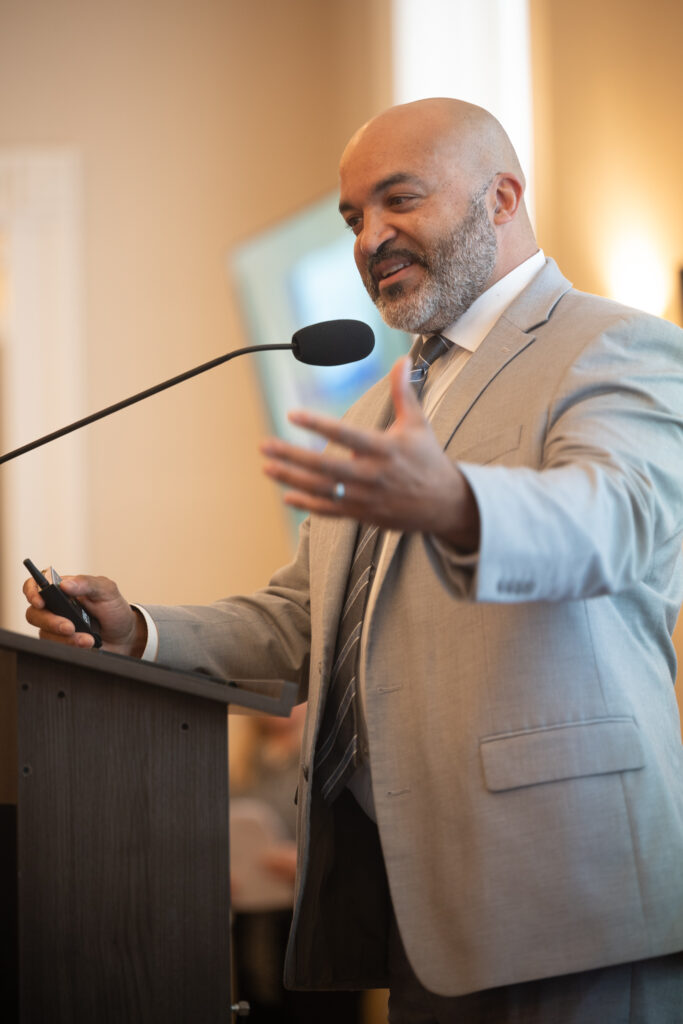
“Good economic development is waking up every day, making sure you have a great place where people want to live, work and play by leveraging the power of the economy,” Gines says. “It’s the improvement of the quality of life for the maximum amount of people by leveraging the economy.”
That definition sat at the heart of his message. Artificial intelligence is not separate from economic development. It is now part of it. It touches workforce, small business, infrastructure, entrepreneurship, government operations, data security, energy use, community values, and the future of work itself.
Gines began by grounding the conversation in Talbot County’s own identity. He noted what he had heard from people in the room that Talbot County is a place that invests in its people, values its nonprofit sector, cares about its future, and wants to grow without losing sight of the residents who make the community what it is.
That matters, he says, because AI is not simply a technology question. It is a values question.
“Values is the litmus test, not the technology,” Gines says. “It’s creating the values, living up to the values, the ethos of Talbot County, who you are, what you want to be, and using that as the filter for whatever comes next.”
The pace of change is staggering. Gines reminded the audience that ChatGPT became public in November 2022 and rapidly grew to hundreds of millions of users. Other tools, including Claude and Gemini, are growing as well. AI technology is advancing so quickly that communities cannot possibly keep up with every new model, platform, or feature.
Nor should they try.
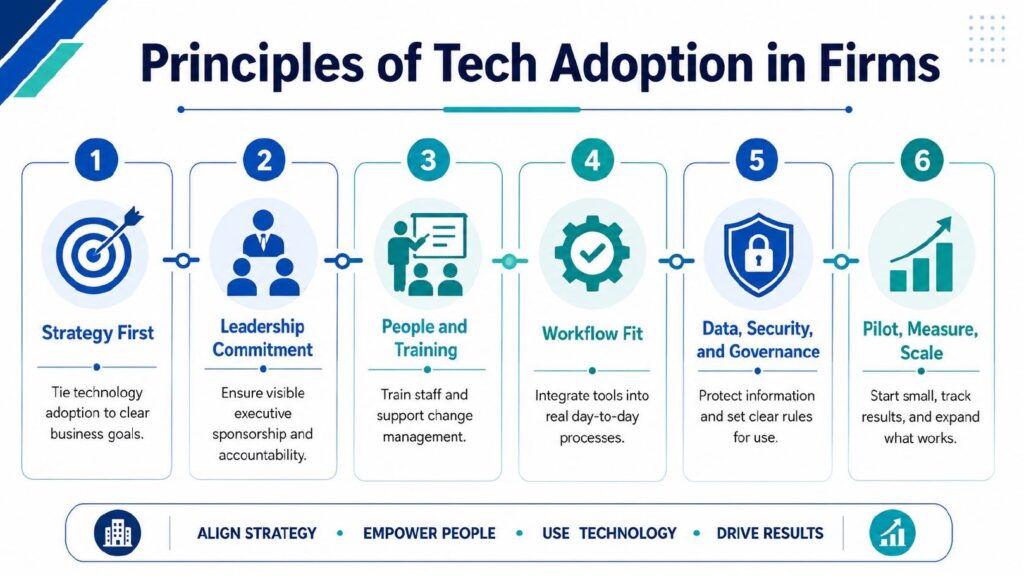
Instead, Gines says, communities and organizations need a framework. They need to understand what AI can do, where it creates opportunity, where it creates risk, and how to use it in ways that serve people rather than simply chase novelty.
On the practical side, he says many organizations are still at the beginning. Some employees use AI quietly and informally. Some organizations are trying large-scale implementation without getting meaningful results. Others have not touched it at all. The challenge is not only whether people have access to AI tools, but whether organizations have the leadership, training, governance, and workflow discipline to use them well.
Gines compared AI adoption to any other major technology change. No organization would switch from Google to Microsoft without preparing its staff, explaining expectations, providing training, and helping people through the transition. Yet many organizations hand employees an AI tool and expect miracles.
The result is uneven at best.
Used well, AI can change the rhythm of work. Gines described an administrative task that might take two hours: answering a site-search inquiry, reviewing a database, identifying properties, drafting a response, and logging the interaction. With the right AI-supported workflow, that work can be reduced to minutes.
That is powerful. It can free people to focus on higher-value work. It can help small teams do more. It can give entrepreneurs access to planning, marketing, financial, and administrative support that once required far more working capital.
For a small business owner, Gines says, a $20-a-month AI tool can reduce startup costs and allow more money to go toward building the business, making sales, improving operations, or hiring people with skills that cannot be easily replaced.
But every opportunity carries a question.
If AI can turn a two-hour task into a five-minute task, what happens to the worker whose job was built around that process? If entrepreneurs rely on AI for marketing plans, bookkeeping, writing, and research, what happens to the local service providers who once performed that work? If thousands of businesses and organizations adopt these tools at scale, what happens to the broader labor market?
“This is the most critical and important conversation we need to have,” Gines says. “On the front end, it creates benefits. On the back end, it creates massive disruption for massive amounts of people, massive amounts of communities, massive amounts of infrastructure.”
That infrastructure piece is often overlooked. Every AI prompt depends on data centers, power, utilities, and physical systems that most users never see. Gines says the two AI conversations he hears most often are how to get more people using the tools and what communities should do about data centers. Those conversations are connected.
More AI adoption creates more demand for computing power. More computing power creates more demand for energy and infrastructure. Communities cannot talk seriously about AI without also talking about land use, utilities, energy capacity, environmental concerns, and long-term planning.
For Talbot County, that makes the issue both immediate and strategic. AI can help local businesses, nonprofits, government agencies, and entrepreneurs become more efficient. It can support innovation, workforce development, and service delivery. It can help people compete. But it also requires safeguards for workers, residents, data, and community character.
Gines offered a community-level framework: assess what is happening, understand readiness and risk, build trust, equip people with skills, apply the tools thoughtfully, protect workers and data, support local innovation, and share prosperity.
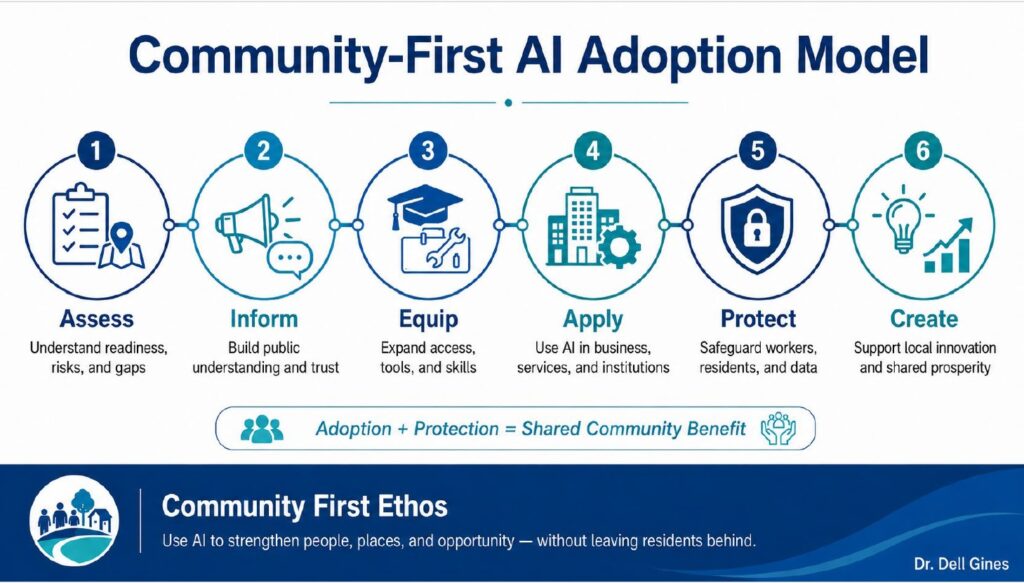
That final phrase may be the most important. Share prosperity.
For Gines, artificial intelligence should not be measured only by efficiency gains, cost savings, or speed. It should be measured by whether it helps a community become stronger, more resilient, and more inclusive. It should be judged by whether it improves quality of life rather than simply replacing human effort.
He calls this moment “the golden age of artificial intelligence,” not because the technology is perfect, but because it is powerful enough to matter and still new enough to be shaped. Corporate interests have not completely defined the future. Local communities still have time to decide how they will use AI, what they will protect, and what they want the technology to make possible.
Talbot County, he says, has a choice.
It can be dragged along by forces outside its control: corporate priorities, market pressures, technology cycles, and decisions made elsewhere. Or it can step back, think clearly, and adopt AI in a way that reflects local values.
“You can say we’re going to step back and we’re going to think about how to adopt this technology in a meaningful way that preserves and protects our people while puts us at the maximum opportunity for improving our community over the future,” Gines says.
That is the conversation now before Talbot County. Not whether artificial intelligence is coming. It is already here.
The question for Talbot County is how to use AI with intention: how to prepare workers and businesses for change, help small organizations and entrepreneurs use new tools wisely, protect data, understand infrastructure demands, and ensure technology serves the community’s values rather than defining them.
For a community built by people who invest here, employ here, serve here, and continue to believe in this place, the answer matters. As Gines made clear, AI may be powered by data centers and algorithms. But its future in Talbot County should be shaped by its people.
About Talbot County Department of Economic Development and Tourism
The Talbot County Department of Economic Development and Tourism’s mission is to enhance and promote a business-friendly environment for current and prospective enterprises and to advocate for policies that support and strengthen the economic vitality of Talbot County. The department’s vision for Talbot County is built on the principles of strong communities, empowered businesses, and innovative solutions.
Never Miss Talbot County Business News:
Subscribe to the Talbot Works newsletter here.
Wait! Before You Go!
Don’t forget to Explore Talbot County with us here.